Hardly anyone knows this difference – and that is precisely why many catering establishments deliberately exploit it:
The supposed "Prosecco on tap" is in reality not Prosecco, but Frizzante or any other sparkling wine.
The term "Prosecco" is often misused here purely as a sales strategy.
But why is that? And what makes real Prosecco so different?
Click here for the 1st ORF article.
Click here for the 2nd ORF article.
What Prosecco really is
Prosecco is neither a buzzword nor simply a flavor.
It is a strictly protected designation of origin from Veneto and Friuli, made from the traditional Glera grape and subject to a consistent control system in Italy.
Every bottle of Prosecco represents a binding quality promise. To ensure this is met, clear rules apply:
- Original bottle instead of draught: Prosecco may only be sold in its original bottle.
- Anchoring in the region of origin: Only sparkling wine from the legally defined zones may be called "Prosecco."
- Complete traceability: Each bottle carries a control number.
This creates a product that stands worldwide for freshness, elegance, and authentic Italian craftsmanship.
Why Frizzante from the tap is not Prosecco
Many guests believe that "Prosecco from the tap" is simply a practical alternative.
In reality, this is not legally permitted.
If a sparkling wine is filled into a barrel, a dispensing system, or a tank, it automatically loses the name Prosecco – even if it had been filled with real Prosecco before.
The reason is simple:
Prosecco may only be sold as a bottled product.
As soon as it is decanted, it is legally no longer Prosecco.
What remains is sparkling wine or generic semi-sparkling wine – often cheap industrial quality.
How restaurateurs misuse the term "Prosecco"
Here begins the real problem.
Many establishments still write "Prosecco on tap", even though they know perfectly well that it isn't.
Why?
Because the name sells. Because it sounds better. Because guests don't ask.
For the establishment, this means:
- higher sales price
- very low purchase costs
- better margin
For the guest, it means:
- less quality
- a product that is not what it is sold as
So it's not a stylistic device, but simply an intentional misrepresentation!
What is actually in the barrel
Behind the alleged barrel Prosecco is usually:
- Frizzante (semi-sparkling wine with lower pressure)
- Industrial sparkling wine
- Mixed products
- Generic, cheap semi-sparkling wines
These products have nothing to do with the quality standard of a Prosecco DOC or a DOCG from Valdobbiadene.
Why genuine Prosecco producers never offer draught products
Renowned houses consciously and exclusively rely on bottle filling, because this is the only way to guarantee:
- the characteristic fine perlage
- the authentic taste of the Glera grape
- consistent quality
- certification and traceability
Frizzante vs. Spumante – the difference in pressure
Frizzante is a semi-sparkling wine with less pressure in the container (usually 1-2.5 bar). It appears lighter, less sparkling and often simpler in taste. Many draught wines fall into this category.
Spumante, on the other hand, is sparkling wine with higher pressure (at least 3.5 bar in the bottle). The perlage is finer, more persistent and the quality is significantly higher.
Conclusion: Prosecco is Prosecco – everything else is Frizzante and co.
The myth of "Prosecco on tap" persists, but it is simply false.
If you want to enjoy real Prosecco, you have to grab the bottle.
Anything that comes from a tap is semi-sparkling wine – never Prosecco.
And a little awareness helps to avoid being deceived in a restaurant.
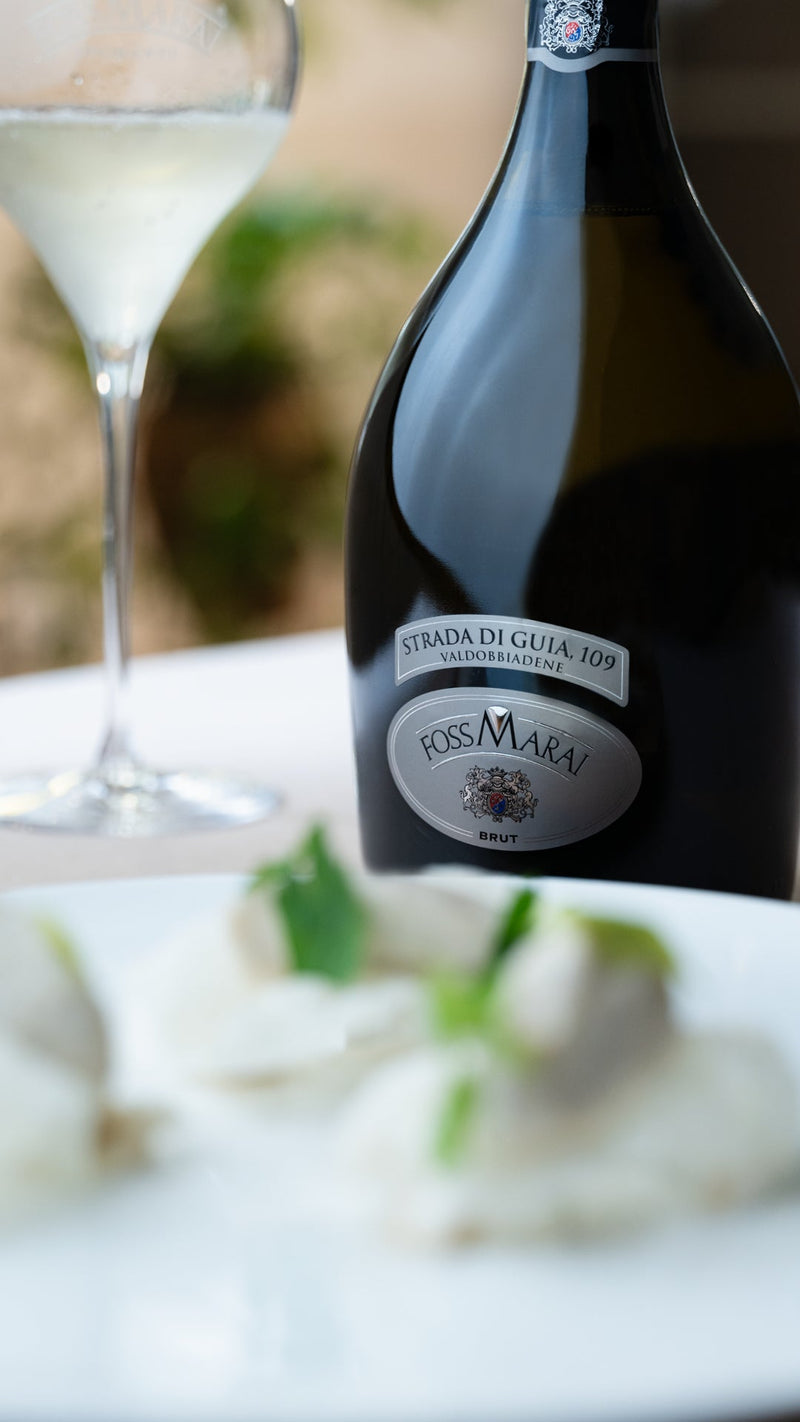
Curious about real Prosecco? Try our popular Foss Marai Strada di Guia 109, Brut DOCG.